Mechanism of Action Studies
Why Enzymatic Seaweed Extraction Outperforms Chemical and Physical Methods
Abstract. Seaweed extracts are widely used as biostimulants, yet their agronomic efficacy is dictated not by biomass quantity but by the integrity and bioavailability of native bioactive compounds. Conventional chemical hydrolysis and cold‑press methods inevitably degrade phytohormones, polyphenols, and polysaccharides. In contrast, MacroAlga’s proprietary 100% enzymatic hydrolysis—exemplified by the KEYO® series—operates under mild physiological conditions, converting high‑molecular‑weight alginate into low‑DP, unsaturated alginate oligosaccharides (AOS) while preserving intact auxins, cytokinins, and betaines. This review compares enzymatic, chemical, and physical extraction across biochemical, agronomic, and environmental dimensions.
1. Introduction
Brown seaweeds (Ascophyllum nodosum, Ecklonia maxima, Laminaria japonica) accumulate complex secondary metabolites that regulate plant growth, stress tolerance, and nutrient use efficiency. The industrial challenge is not extraction itself, but how to liberate these compounds without destroying them.
Three fundamentally different paradigms dominate the market:
- Chemical hydrolysis: Alkaline or acidic digestion of cell walls.
- Physical methods: Cold pressing or mechanical cell disruption.
- Enzymatic hydrolysis: Substrate‑specific glycoside hydrolases acting under mild conditions.
Only enzymatic extraction achieves simultaneous polysaccharide depolymerization and bioactive preservation—a requirement for modern high‑performance biostimulants.
2. The KEYO® Enzymatic Process
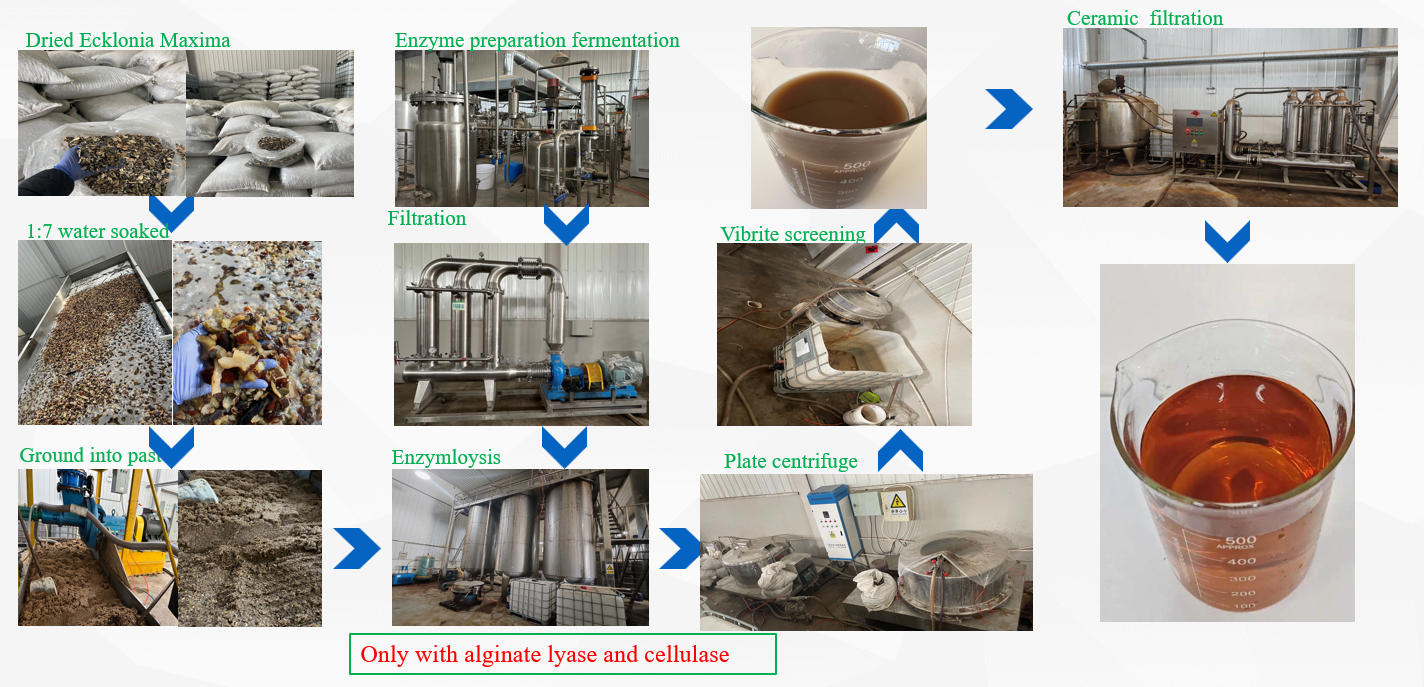
MacroAlga’s KEYO® enzymatic seaweed extract is produced without any chemical additives. The process relies exclusively on proprietary alginate lyase (300,000 U/mL) and cellulose enzyme, operating at 40–50 °C for 12 hours.
2.1 Process Flow (Ecklonia maxima as Example)
- Soak dried Ecklonia maxima flakes in water for 48 hours.
- Grind kelp into a homogeneous paste.
- Add cellulose enzyme, fucoidanase, and alginate lyase into the reactor.
- Hydrolyze at 40–50 °C for 12 hours for complete enzymatic conversion.
- Ceramic membrane filtration yields a clear, stable extract suitable for chelated micronutrients.
2.2 In Situ Alginate Oligosaccharide Formation
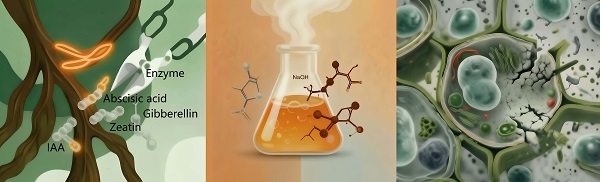
A critical advantage of enzymatic hydrolysis is the in situ conversion of alginic acid into AOS. Alginate lyase cleaves the polymer via β‑elimination, generating unsaturated DP2–DP4 oligosaccharides with a Δ4,5 double bond at the non‑reducing terminus. These low‑molecular‑weight AOS are the primary drivers of root development, salinity tolerance, and nutrient uptake—benefits absent in chemically extracted products.
3. Comparative Analysis: Enzymatic vs. Chemical vs. Physical
| Dimension | Enzymatic Hydrolysis (KEYO®) | Chemical Extraction | Cold‑Press / Physical |
|---|---|---|---|
| Reaction principle | Precise enzymatic cleavage of cell walls | Harsh acids/alkalis, high temperature | Mechanical pressure disrupts cells |
| Phytohormone integrity | Intact auxins, cytokinins, ABA | Severe thermal/chemical degradation | Well preserved |
| Polyphenol retention | High (especially fresh kelp grades) | Oxidized and lost | Moderate |
| Alginate conversion | In situ conversion to bioactive AOS | Random depolymerization, saturated chains | No conversion; large molecules |
| Product DP | DP2–DP4 dominant (optimal bioactivity) | Broad, uncontrolled DP | Native high‑MW polymers |
| Bioavailability | High; small molecules rapidly absorbed | Low; incomplete active spectrum | Limited; poor foliar penetration |
| Environmental impact | Zero chemical discharge | High alkaline/acid waste | Low; high energy consumption |
4. Species‑Specific Bioactivity of KEYO® Extracts
Enzymatic extraction does not homogenize seaweed into a generic input. Instead, it preserves the intrinsic hormonal profile of each species—allowing formulators to match extract type to agronomic need.
| Product | Raw Material | Key Hormonal Traits | Agronomic Target |
|---|---|---|---|
| KEYO® Ascophyllum nodosum | Dried North Atlantic rockweed | Balanced betaines & growth regulators | Abiotic stress tolerance, fruit quality |
| KEYO® Ecklonia maxima | Dried South African giant kelp | High auxins & cytokinins | Root initiation, vegetative growth |
| KEYO® Laminaria japonica (Fresh) | Fresh kelp, processed < 24 h | Highest polyphenol content | Balanced bioactives, full‑cycle health |
5. Quantified Performance Advantage
Independent profiling of enzymatic Ecklonia maxima extract (Zhongxi Research Institute, Report ZX240312‑C090101) demonstrates the retention of native phytohormones:
- Gibberellin: 100.04 ng/g
- Zeatin: 63.79 ng/g
- IAA: 39.95 µg/kg
- Abscisic acid: 0.61 µg/kg
- Total polyphenols: 229.57 µg/mL
- Alginate oligosaccharide content: ≥ 25 g/L in stock solution
These values are unattainable in chemically hydrolyzed products, where heat and pH extremes destroy labile hormones and oxidize polyphenols.
6. Conclusion
Enzymatic seaweed extraction is not merely a gentler alternative—it is a fundamentally different biochemical process. By converting high‑molecular‑weight alginate into unsaturated, low‑DP oligosaccharides while preserving native phytohormones, enzymatic technology delivers a level of structural precision and bioactivity that chemical and physical methods cannot match.
For formulators seeking reproducible agronomic outcomes, the choice is not between “seaweed extracts,” but between random degradation and rational molecular design. The KEYO® enzymatic platform represents the latter.
About Qingdao MacroAlga Co., Ltd.
Qingdao MacroAlga is a technology‑driven manufacturer specializing in enzymatic biostimulant raw materials. Backed by proprietary enzyme platforms developed at the Qingdao Institute of Bioenergy and Bioprocess Technology (CAS), MacroAlga operates large‑scale, fully automated enzymatic production lines for chitosan oligosaccharide, alginate oligosaccharide, and species‑specific enzymatic seaweed extracts (KEYO®). With a strong focus on structural precision and third‑party validated quality, MacroAlga supplies high‑performance ingredients to leading fertilizer and agrochemical formulators in over 30 countries.
Contact: Kevin Zhang
Tel / Mobile: +86 135 0543 8449
R&D Center: No. 239, Keyuanjing 3rd Road, Laoshan District, Qingdao, Shandong
Factory: No. 88, Longquan Street, Xiazhuang Town, Gaomi, Weifang, Shandong
Website: www.macroalga.com
